17 Nov 2026
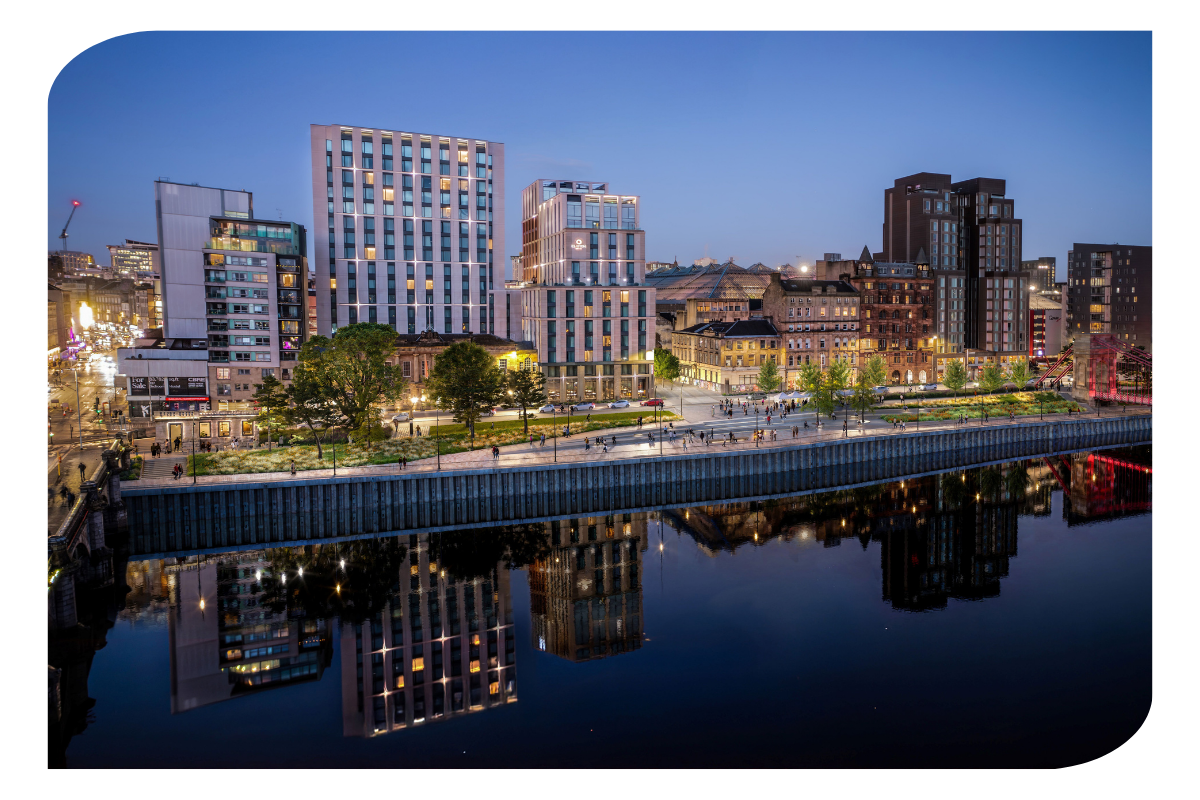
The regeneration of Glasgow city centre has moved forward significantly in 2026, with a council committee given an update on the City Centre Strategy today (17 November).
The City Centre Strategy (CCS), which runs until 2030, is the overarching document guiding the city centre’s transformation and aims to make the city centre and its experience more attractive for residents and visitors, boosting footfall and supporting the delivery of enhanced public spaces and infrastructure.
The update on the CCS included detail on the ongoing response to the Union Street fire; continued promotion of what the city centre has to offer; enhanced transport services, particularly at night; greater support for the night-time economy; strong footfall figures relative to Glasgow’s comparator cities; enhanced and expanding cleansing operations; the establishment of a Business Improvement District; the development of plans to regenerate both banks of the Clyde; action to build more homes in the city centre; and the progress of the Sauchiehall Street Culture and Heritage District.
Councillor Angus Millar, Convener for City Centre Recovery at Glasgow City Council, said: “Over the last year, major progress has been made in the regeneration of Glasgow city centre despite some significant challenges. The transformation of city centre streets and places may be the most obvious change – but a lot of work between the council and our partners has made the city centre more successful than our competitors, provided resources to make the environment more attractive for everyone, and brought a real focus to improving transport options to and from the city centre, especially at night.
“We are laying the groundwork for the city centre’s future success, and we will continue to enhance the city centre’s look and feel and drive increased footfall while working with private building owners and developers to find solutions for key city centre sites.”
The CCS is overseen by the City Centre Task Force, co-chaired by Councillor Angus Millar and Stuart Patrick, Chief Executive of Glasgow Chamber of Commerce. The City Centre Taskforce identified four priority actions for the city centre:
In 2026, these priority actions were progressed as follows:
Improve Look, Feel and Experience
Union Street: in response to the major fire at the Union Street site in March 2026, recovery activity began and in July, site clearance and stabilisation works finished and the site was then handed back to owners. After this, two phases - the first celebrating the Glasgow 2026 Commonwealth Games, the second featuring civic messaging - of graphic hoardings were installed around the site. The council has since - in collaboration with the site owners - appointed O'Donnell Brown to develop a meanwhile use proposal for the site before it is redeveloped in the medium-term.
Work is also progressing on the brief for the Central Station and Union Street Area Study - the study will establish a longer-term vision for the area, seeking to transform it from a transitional space into a destination in its own right.
Anderston Station Plaza: The RIBA Stage 4 design is nearing its final phase with an online public consultation finishing this weekend. Construction is expected to begin in the summer of 2027. This project will deliver an upgrade to the road crossings on both the off and on-ramps providing a segregated cycle route and improved pedestrian connectivity, and the station environs will benefit from a focus on lighting, safety, and decluttering the space including the removal of the pedestrian bridge, to create a more welcoming and coherent environment.
Launch a Marketing Campaign
The Get You In Town campaign was developed as a long-term campaign framework for local Glasgow audiences, designed to sit under the ever-popular People Make Glasgow brand to provide a strong call to action to encourage footfall into the city centre. In 2026, Get You In Town was used to encourage visitors after the Union Street fire and work to encourage business take-up to support the longevity of the campaign. The campaign is also supporting the Christmas celebrations in the city centre.
Improve the Transport Offering
A key ask from the City Centre Taskforce was that transport operators provide opportunities for service improvements and this led to the Glasgow Subway delivering enhanced operating hours, bus operators introducing additional evening services and Scotrail increasing the frequency of evening services. In addition, the Night Bus Hubs pilot - developed in partnership by the council, Let’s Go Glasgow, and First and McGill’s - began in October, with three bus hubs in the city centre offering improved safety, visibility and awareness with marshalling and strong CCTV coverage and lighting levels.
Throughout 2026, event organisers and transport operators came together to deliver major events, including the World Cup, Commonwealth Games, TRNSMT and large concerts at Hampden and the Hydro. Transport operators increased service capacity and extended running times to support events - with one example being bus operators running their night services during weekday Scotland football matches.
Night-Time Economy
The Nightshift: Glasgow strategy was launched in 2026 to support and develop Glasgow's nighttime economy through the promotion of a 6pm - 6am city strategy, recognising nightlife as an essential part of Glasgow's economic and cultural life. The aim is to create a safer, more vibrant, and better-supported night-time environment for businesses, workers, residents, and visitors.
Glasgow city centre continues to attract relatively strong footfall figures against comparator cities such as Edinburgh, Manchester and Leeds - half-year data for 2026 show a small decline in city centre footfall (-2.9% as a whole), with the decline slowing down consistently since April. Footfall is very strong in the Commercial district (which includes the IFSD and Barclays Campus) with a 9.2% rise this year. The trend of weekends and evenings performing above average continues, showing the new way in which people are interacting in the city centre. International footfall has also been particularly strong - a 13.3% rise - with sales slightly under last year’s levels (-1.7%) but well ahead of comparator cities and the UK average. The Fashion sector shows an 8.3% increase in sales, boosted by a number of retail openings in the past 18 months.
The following vital work to improve and develop the city centre has taken place this year:
The Glasgow City Centre Strategy 2024-30 can be found at: https://www.glasgow.gov.uk/article/1831/City-Centre-Strategy-2024-2030